


 Larger Text
 Smaller Text
 Print



Proud Sponsor of

MATLS 4NN3/6NN3: COMPUTATIONAL MODELLING IN MATERIALS ENGINEERING
Instructor
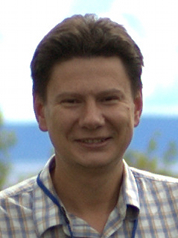
Oleg Rubel |
 |
|
| Room: | JHE 359 |
|
| Tel: | +1-905-525-9140, ext. 24094 |
|
| E-Mail: | rubelo(a)mcmaster.ca |
|
| URL: | http://olegrubel.mcmaster.ca |
|
Course structure
12 weeks, 3 hrs/week: 1 hr lecture, 2hrs hands on session (tutorials)
Module 1 (week 1–2): Fundamentals of density functional theory (DFT)
- elements of quantum mechanics
- ab initio approaches in historical perspective
- DFT shortcut
- self consistency problem
- basis set
- pseudopotentials
- software (Wien2k, VASP, ABINIT)
- Tutorial: VESTA building and visualization of simple crystal structures
- Tutorial: ABINIT under Windows/Linux, analysis tools
Module 2 (week 3–4): Prediction of basic material structure
- equilibrium structure
- phase stability
- phase diagram
- convergence and accuracy
- Tutorial: stable structure of Fe (bcc and fcc phases, magnetism)
Module 3 (week 5–6): Mechanical properties
- elastic properties
- equation of state (EOS)
- strength and fracture toughness
- Tutorial: lattice constant and bulk modulus of Si, convergence test, MATLAB code for EOS fit
Module 4 (week 7–10): Optical and electrical properties
- band structure
- transport coefficients
- Tutorial: Band structure of GaAs and Si (direct vs indirect semiconductors)
- Tutorial: Charge transport and effective mass
- Tutorial: Band gap engineering in (InGa)N
- polarization
- piezoelectric properties
- Tutorial: Electromechanical coupling in ferroelectric ceramics PbTiO3
Module 5 (week 11–12): Structural defects and impurities
- supercells
- structure relaxation
- formation energy
- defect electronic states
- Tutorial: Solubility of C in fcc-Fe and bcc-Fe
- special topic project (6NN3)
Graduate students (6NN3) are required to develop an individual or a small group project
where they apply the learned techniques to solving a problem in materials science of their
choice. At the end, students are asked to write a report paper in the form of a wiki page.
Learning Outcomes
- Basic knowledge of quantum-mechanical concepts used in computational modelling of materials.
- Use existing DFT programs for the quantitative simulation of intrinsic material properties.
- Ability to develop structural models that capture relevant interactions for a material property in question.
- Know how to interpret computational results and compare between computational and experimental results.
- Efficiently utilize Linux-based multiprocessor servers for solving demanding computational and data-intensive problems.
Activities |
Contribution to the final grade | |
|---|---|---|
| 4NN3 | 6NN3 | |
Assignments (1 per module) |
50% |
40% |
Final exam |
50% |
40% |
Special topic project |
-- |
20% |
Prerequisites and relevance to other courses
The material covered is largely self-contained, but an earlier exposure to quantum me-
chanics and solid state physics (MATLS 3Q03 Materials for Electronic Applications) is
desirable. No extensive programming knowlege is required.
Recommended texts include but not limited to the following titles
- June Gunn Lee, Computational materials science: an introduction (CRC Press, Taylor & Francis Group, 2012).
ISBN: 978-1-4398-3616-3 - David S. Sholl and Janice A. Steckel, Density functional theory: a practical introduction (John Wiley & Sons, 2009).
ISBN: 978-0-470-37317-0 - Efthimios Kaxiras, Atomic and electronic structure of solids (Cambridge University Press, 2003).
ISBN-13: 978-0521523394
Notes: The text by Lee gives a great introduction to the quantum mechanics and DFT. The text by Sholl and Steckel complements with a good set of examples, but is more shallow in terms of the DFT theory. The book by Kaxiras is more general and cover many aspects apart from DFT.